


Rachael Nemeth, co-founder and CEO of Opus Training, joined me to share how Opus leverages real operational data to deliver personalized, actionable training in over 130 languages through mobile devices to bridge the learning gap for the 110 million Americans who aren’t desk-based. This was a fascinating conversation, if for no other reason than so few companies focus on these front-line workers and that the training Opus provides isn’t your standard compliance-based stuff, but the education that will most benefit individual employees, teams, and sites based on their actual performance on the job.
Rachael shared her own journey from the restaurant industry to building Opus. Our conversation explored the shortcomings of traditional training metrics, the importance of manager enablement, and the need for technology that truly serves and empowers America’s frontline workforce.
Michael Horn
Welcome to The Future of Education. I’m Michael Horn. You’re joining the show where we’re dedicated to creating a world in which all individuals can build their passions, fulfill their potential, and live lives of purpose. And to help us think through that today, I’m really excited because we get to focus on an area we don’t talk nearly enough, in my opinion, about in the conversation around helping individuals skill up and figure out potential and so forth. And none other than Rachael Nemeth. She’s the co-founder and CEO of Opus Training, which we’re going to hear all about today. But I think the motto is turning training into traction. Rachael, thank you so much for joining us.
I’m excited to hear about your story and about Opus.
Rachael Nemeth
Yeah, thanks for welcoming me. I’m excited to be here.
Michael Horn
Yeah, you bet. So, why don’t you just start us off, like baseline, you know, tax, like what is Opus Training before we get into the backstory of how you created it?
Rachael Nemeth
Yeah, so when you think about the 2,100 learning management systems that are in the world today, it’s obviously just from that number, it is a very fragmented market. Opus is a training operating system that’s designed specifically for the 110 million Americans who aren’t sitting at a desk all day. So, it is a big product for a big workforce that is largely underserved. What’s special about Opus, though, is that we aren’t just helping teams create training, which is kind of, you know, a lot of what you see in a traditional learning system. We’re actually helping operators change behavior in their workflow by using live operational data from the business, which we’ll talk a little bit more about. Yeah. But we’re sort of taking knowledge to the next level, knowing that this workforce is changing.
Michael Horn
Okay, I have so many questions that I’m excited to geek out on this, but let’s back up a little bit. Tell us the story. Most people don’t focus on the frontline, as you said, right? And the people who are not in front of computers when they picture their upskilling or reskilling platforms. How did you decide to build Opus Training? What was the background that you brought to it and the problem that you saw that you wanted to solve?
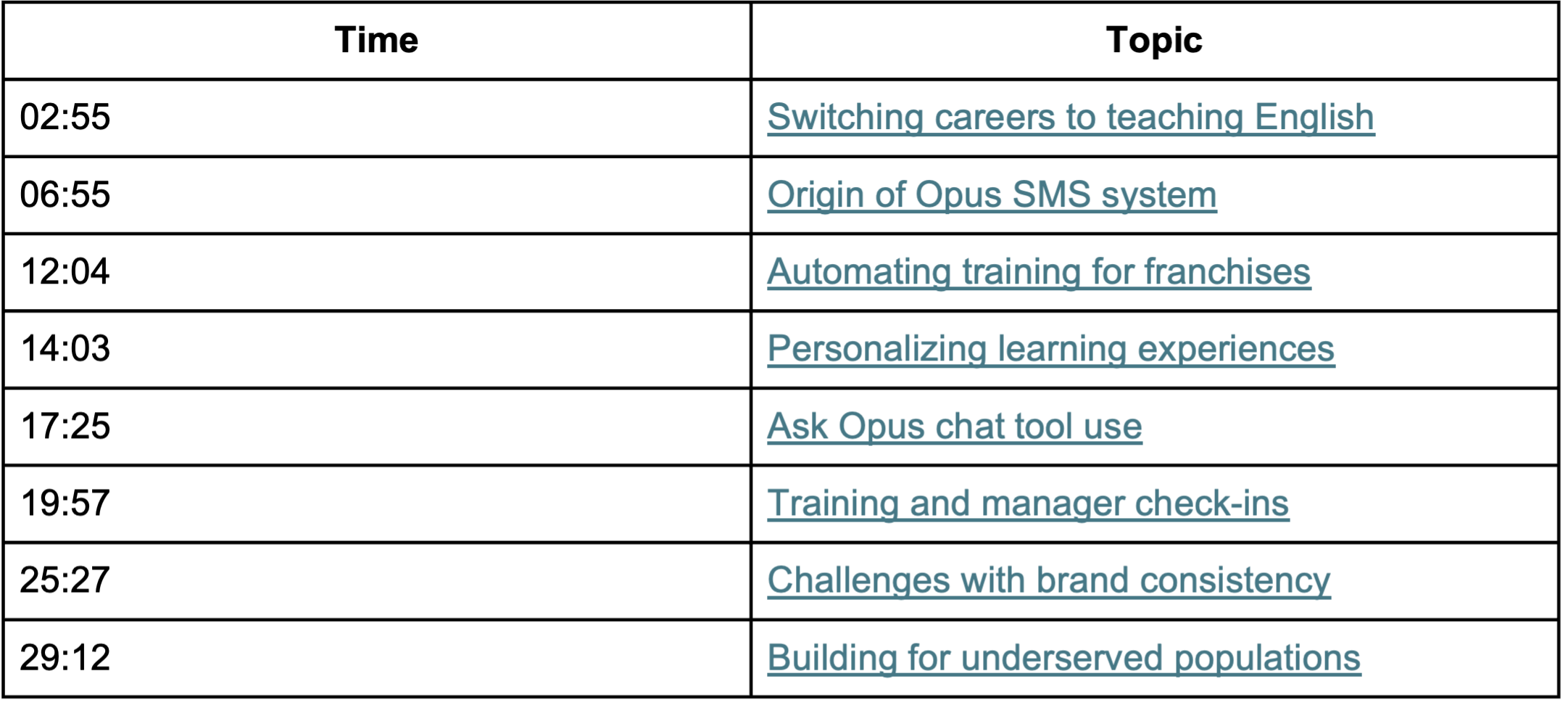
Switching careers to teaching English
Rachael Nemeth
It was definitely not an overnight, you know, light bulb moment. Maybe just to rewind, so my background is not in tech. It’s actually early. It was not in teaching either. My background’s in restaurants. So, I worked for 13 years in the restaurant industry, most recently for Danny Meyer at Union Square Hospitality Group.
Michael Horn
Best hospitality anywhere.
Rachael Nemeth
If you’re a foodie, you know Danny. And before that, I cut my teeth in baking manufacturing. My mom worked in bakeries for 43 years. My grandfather owned a barbecue chain in Kansas City called Don’s World of Beef. So, I have this sort of rich family history of the food service. And candidly, I thought I was kind of destined for it. And also very candidly, I spent my whole life trying to get out of the industry. It is a terrible industry.
You’re overworked, you’re underpaid.
Michael Horn
Listeners know my wife’s,, that’s her background and her industry and Some of the work conditions and personalities, shall we say, are not Danny Meyer. So, yes, I get it.
Rachael Nemeth
And I still eat spaghetti over the sink. Like, I do not go out to fancy dinners. I still eat on the go because that is the life I’ve lived. But maybe just fast forward to about 10 years ago, I was looking to make a transition. And so, I quit the industry to start teaching English as a second language. My second passion is language. And within a couple of months of teaching and getting my certification and thereafter starting to earn my master’s, I got pulled back into the industry. I got a call from the executive chef of Gramercy Tavern, Mike Anthony, who said, hey, I hear that you teach English and you know restaurants.
And I said, yes, what’s your point?
Michael Horn
Guilty on both, yeah.
Rachael Nemeth
And I was like, how did you find me? And he said, I want you to teach English to my kitchen team. And I filed for the LLC for ESL Works the next day.
Michael Horn
Wow.
Rachael Nemeth
I had always wanted to run a business. I had always wanted to be an entrepreneur. I grew up in a very entrepreneurial family, but I never was chasing an idea. I’m a big believer in ideas that sort of float around and it’s if you catch them, you do. So, I chased it and the next day ESL Works was born. That was 2013. I basically ran a logistics business. I was hiring green, fresh out of college teachers, and I was teaching them how to teach English in restaurants.
They were, I was deploying them across all of Manhattan and Brooklyn and Queens to teach a 90-minute English class between shifts. So for anyone listening who has not worked in a restaurant, that is the only time you can effectively teach a classroom training. People have second jobs and kids and commutes and all these other things. That was very successful. I wouldn’t call it a brick and mortar because I didn’t have anything except whiteboards that I was taking on the subway, but it was a really successful services business. And when we got to, you know, a few years in and we really wanted to scale, the only options were franchise or license or digitize and productize.
And the latter was obvious to me, but I didn’t know how to do it. So, I spent about 18 months in incubators and testing different products. I ended up landing on a product that delivered English language training over SMS and WhatsApp to frontline teams. At that point, it was still specifically in restaurants, but then this is sort of the untold story. So that was, oh my gosh, you know how when you think back on time, you say 10 years for so long and then you’re like, wait, but 3 years has passed now.
Michael Horn
3 years. Well, and I think COVID has accelerated that. Let’s be clear. I was talking to someone, they were like, how long have you been doing X? And I was like, it could be 3 years, but it also could be 6. I’m not sure. Oh yeah, I get it.
Origin of Opus SMS system
Rachael Nemeth
So, so, you know, this is like, I was joking with my aunt the other day, like she was saying, you know, there’s a difference between a biography and a memoir,a memoir is what you recall. And so anyway, this is my memoir of the timing, but COVID happened. So March 13th, I got a call from a customer. We had already launched this SMS product. I was actually in the middle of raising a round of funding, a seed round of funding. And they said, we’re shutting down. And then, of course, you know, the CDC announced and everything shut down, and I said, well, how can I help? And he said, I’m not sure, but like, we obviously don’t need ESL right now.
The next day, I went home, called all of our customers, and said, you know, and at that point, the world had shut down.
Michael Horn
Right.
Rachael Nemeth
I said, listen, like, we’re not going to invoice you. We know this is a nightmare. Whatever we can do to help, just let us know. So, I can’t take credit for this idea because our customers came up with it, but they said, listen
Michael Horn
Those are the best ideas though, right? Where your customers bring you to something of real demand and need.
Rachael Nemeth
Yeah. And this, talk about ultimate need, right? Like, it was the beginning of COVID, everyone was on lockdown, but restaurants were switching their operating model to off-premise. They were online and they needed to keep their employees safe. So, we repurposed The ESL Works SMS product into a COVID safety product that delivered daily SMS messages and quizzes to team members before they went in for their shift so that they knew what was new and how to feel safe and protected at work. It was a public initiative. I had, I think, a quarter of a million dollars in the bank and a prayer and didn’t charge a thing and basically said, we’re gonna just try to help and see what happens. We grew to 20,000 users in 4 weeks.
Michael Horn
Wow. 20,000 users, meaning like different businesses?
Rachael Nemeth
Different businesses. Yeah. Again, I mean, this was so lightning fast. Actually, if you go to Wayback Machine, you know, that online, you know, database where you can see old websites, you can probably look up Stop COVID still and see our old website. But we lost the URL long ago. I was like, I don’t want to think about COVID ever again, but But the premise was that a business could go to the website, they could sign up very quickly, they could upload a spreadsheet or CSV of all of their employees’ names, phone numbers, and it would text their whole team instantly in 5 different languages ,these updates. But that was all the validation I needed to know how to scale this thing, right? Now, fast forward, and Opus is no longer on SMS. We have a beautiful mobile app and all these other things, but that’s really the root of Opus.
It was this kind of volunteer project. I had amazing engineers who were also volunteering, many of whom still work with us today, but now I pay them. And to your point, it’s sort of like the purest product development story of customers having a real need and meeting them in the moment to get it done.
Michael Horn
Super interesting. So now you fast forward, you’re working with a lot of restaurants people would know the names of Luke’s Lobster, right? Like Just Salad, the José Andrés Group, right? And restaurant Smashburger, et cetera, et cetera. As I understand it, you probably have many, many, many, many more. And, and you mentioned that you’re doing training based on the, I think you said something like the data that they recognize is most crucial for their own operations.
Which I assume is in contrast to training data that someone else once thought was important as a static sort of living thing, as opposed to, which sounds much more emergent based on the needs of the business. But maybe unpack that, tell me where I’m wrong, and how do you build training around that on demand, and if that’s the case?
Rachael Nemeth
Yeah, and I mean, I’ll give you the quick summary of it, and then maybe we can rewind and just talk about metrics too, because I feel like some metrics are just so backwards these days, but very strong opinions about the word engagement. But basically, I’ll give you like a practical example.
Michael Horn
Perfect.
Rachael Nemeth
Imagine that you are a Paris Baguette, right? You’re a fast-growing brand, hundreds of locations, and you get all of this feedback from your guests on Google and Yelp and all these things. And you’re, you really are probably aggregating that data somewhere with your marketing team, right? Like they’re trying to figure out what people like, what they don’t like, how they respond to the brand. The status quo today is that training and operations teams are getting none of that data, but it directly relates to them, right? Those are the teams that they work with every day. So, what we can do at Opus is we can pipe those Google reviews into Opus, and we can analyze it and automatically generate recommendations.
Automating training for franchises
Rachael Nemeth
Based on the trends that we’re seeing against a location, a franchise, an individual, and we can use that to automatically generate a course. You know, maybe it says, hey, you know, Michael, you know, you’re saying that you have this pastry, but none of your team knows what it is. We actually need to train them on it. Or maybe it’s just a retrain, or maybe it’s something like rewarding your team. Hey, you’re getting lots of 5-star reviews. So, think about what difference that makes for your team when all of a sudden the training actually becomes relevant, which is really the challenge with today’s workforce is, and I knew this when I was a manager, your wife probably knows this too, I don’t think people realize how fast service businesses are changing.
Michael Horn
Yeah.
Rachael Nemeth
Every day you are looking at the weather to see what your PARS should be and what your inventory should be. You’re seeing if there’s going to be a parade down the street. If 5 people aren’t going to show up, how does that change your operation? So, there’s so much you have to flex. And so, we’re just trying to make it easier for people to respond to that data and activate their team as a result of it. Of course, we have this sort of core product, and we can take training and turn it into really engaging TikTok-style learning experiences. But I always love to nerd out about the recommendation engine because that’s really the kind of core of what we’re trying to do. You hear all these things about training in the flow of work, but a lot of that is candidly like false. That’s not, it’s, it’s just micro-training, which is cool too. Right.
Michael Horn
Which is surely better than probably like a 9-week course that you could imagine. But yes, right.
But, your point is like, this is not only am I actively engaged, but the content itself is much more dynamic relative to whatever the thing that we’ve decided is most important for the business to be getting better at.
Personalizing learning experiences
Rachael Nemeth
We’ve talked so much over the years in learning about personalizing the experience and individualizing the experience, and I don’t think anyone’s really done a great job of it. And I’m not even saying that Opus does a great job of it, but that is the holy grail, I think, that everyone’s trying to seek because classroom training is out, web training is out. We live in an increasingly isolated world where people want to feel more connected. But they don’t have the time to convene. So, how do you make people feel connected to your brand and your customer experience, but also feel like individuals at the same time who have the flexibility to learn? In Opus, they can learn in 130 different languages. They can learn by listening. They can learn by reading if they prefer. 30% of our users prefer to listen to their training and not even look at a screen.
So, there’s so much flexibility to how people learn in the modality, but also in the content, which I think is really what we’re doing, where we’re doing some really cool work right now.
Michael Horn
So, I want to let you show that in a moment, but one thing first, which is it occurs to me what you’ve built is also, I’m assuming it’s like a manager enablement tool as well, because one of the, again, I’m not in the industry, but I hear a lot about it. And one of the things that I see is like, it’s really hard to build really good management that knows, A, how to act and get the most out of your employees, but also like what to say, where, like how to coach, like all those things are really hard. I imagine there’s like a 2-way part of this that you’re enabling, I would think, from what you’ve described.
Rachael Nemeth
Most training programs fail because of manager accountability. I don’t know the statistic, but I can tell you from experience, that’s why they’re failing, either because you don’t have that top-down buy-in, right? The COO doesn’t view this as important as the L&D team, or because the managers don’t understand why this is so important. And so, we built a mobile experience specifically for that busy manager. And by the way, this isn’t just restaurants, right? It’s all services business. So, think about fitness clubs, And anything that’s sort of a customer-facing, you know, car washes, we work with lots of car washes that it’s all the same problem, right? You need for customers, it’s an increasingly competitive world and you need for customers to come back through the door. Yeah.
Michael Horn
And your frontline is literally your front door to that experience. Yeah.
Rachael Nemeth
Correct. And they represent your brand. So, and they’re, you know, they’re young or they’re multi-generational and, You have to cater to a lot of different needs and preferences. So, the manager experience helps enable the manager in a way that it basically gives them a checklist for things they should be looking for when they walk through the door. So, if I’m Michael, I can view that Shirley is behind, and so I need to chat with her. I can view that CJ needs a little bit of coaching, that Ruby needs to be certified in a specific skill. So, think of it as a punch list for managers. They’re spending enough time reacting to the world around them.
Ask Opus chat tool use
Rachael Nemeth
They should have an intelligence tool that helps them coach their team. They have their own coach as well. So, we have a feature, a chat agent, it’s called Ask Opus, where a manager can ask any question they want back to their company’s, you know, knowledge base. And Interestingly, when we released that about 2 years ago, this Ask Opus feature, and our assumption was actually that frontline teams would be using it the most, like the hourly team members. Our top 2 users for that Ask Opus agent are managers and non-English speakers. And you can probably guess why, right? Like, the non-English speakers don’t feel comfortable asking, so they can ask in their native language and get a response in their native language. The managers are getting bombarded with so much new information. all the time that it’s burdensome to remember it.
So, the recall is very poor with the managers. So, Ask Opus helps them surface that information very quickly.
Michael Horn
And also probably without shame that like, I couldn’t remember that arcane thing that came through, right? As well. So, yeah.
Rachael Nemeth
Absolutely. Yeah.
Michael Horn
Super interesting. Why don’t, if you’re up for it, I think you can show a little bit of that experience, maybe. I would love to see it. So our audience is always forgiving of these things, but I think it’d be awesome to show a little bit of what this experience looks like and what these learning opportunities that are geared for the frontline actually look like. Because as you said, this can’t be a web course. This can’t be a thing that you sit down at night for 90 minutes, right? Like it’s gotta be as life happens in the consumable chunks when you have an opportunity, I would imagine, on your mobile phone.
Rachael Nemeth
That’s exactly right. So welcome to the trainee experience. If I am Michael and it’s my, you know, my first day on the job, the most overwhelming thing you can feel as a new hire is sitting in a booth and watching videos for 5 hours and then being told to go straight to the register and, you know, remember everything. So with Opus, you actually have a guideline as a new hire for what you’re expected to learn and when. So this is an example from a customer of ours, and you can see that it’s kind of a branded experience. Each course also includes a quiz. It includes interactive content. So, you can see that this is a very kind of fun, engaging experience.
There’s drag-and-drop questions, all that fun stuff. But when I’m done, I want to talk to someone.
Training and manager check-ins
Rachael Nemeth
So, in the course, you have an option to check in with a manager. This is a really simple example on purpose, but we have a lot of customers that are really adamant about coaching their team, and candidly, like, I am too. I don’t believe that we should ever eliminate in-person training. It is so critical to how people receive knowledge and absorb it, but you have to make it easier for managers to know what to coach on. So, as a new hire, I’m looking at this and I say, okay, I need to talk to my manager and answer this question for him. And then in a minute, we’ll go over to the manager mode so you can see what they’re doing. The other thing I can do as a trainee is complete checklists. But you can also see here that all of this can change into any language you want.
So I can change this into Lithuanian and the entire experience changes for me. I’m going to change it back to English just to, because I don’t speak Lithuanian.
Michael Horn
So we can, so us normies can follow along.
Rachael Nemeth
Yeah. The other thing I might want to do as a trainee is, you know, pull up a quick resource, something like that, but maybe I don’t want to sift through my whole company’s knowledge base. So, maybe I can just ask, you know, what is the newest uniform?
We see a lot of employees, this is a really fascinating product because it’s not only just getting you questions in the or answers in the moment, It’s getting you the resource that relates to it.
Michael Horn
So, it’s giving you an answer, plus if you want to train on it.
Rachael Nemeth
If you want to go through it again, it’s a brief answer, so you get the question fast, but most employers do not know what knowledge gaps their team has, and Ask Opus helps them identify it. So, they’re making pretty big swings on, you know, what their team might need, but we just had a customer today. It’s a very large, fast-growing brand, and 58% of their Ask Opus responses came back with no resource attached, which meant that their knowledge base is lacking. And I think in their case, what was lacking was recipe data. So, it’s just interesting to see what, you know, a team wants to experience and what they want to know. And so, it’s a really cool way to sort of crowdsource what needs to come next from your team.
Michael Horn
Well, you’re making me also, a bunch of things are pinging for me, but one of them is a friend of ours, Steve Spear. He did all this research on like what makes Toyota basically better than the Detroit automakers at the time. And one of them was training because what he learned was like, you showed up to the job at Detroit and they were like, okay, watch how I install the front seat. You know, these are the 10 moves I make in 90 seconds. Okay, your turn, go for it. You’re on the line. Whereas at Toyota, they’re like, Okay, when you master step 1, then we’ll go on to step 2. And you realize that’s really hard to do in a frontline job to set up that sort of mastery-based learning environment.
If you can surface, to your point, these gaps of an individual, then as a manager, or I suppose as the system, right, both things can do a much better job of saying, hey, Michael, you seem to be constantly checking on the protocol around this or how we greet here or whatever it is.
Let’s give you a little bit more support and handholding to make you feel confident and perform as we want our brand to be represented.
Rachael Nemeth
That’s half the battle, right, is the confidence that someone needs to be able to operate independently in their job. And I feel like that’s a lot of what’s missing from how we talk about learning and talk about training is like, this is about confidence and independence. It is not about mastery. And I think I think that that’s what we’re getting wrong in the conversation right now as it pertains to the frontline. Do people want certification? Of course.
Michael Horn
Yeah.
Rachael Nemeth
But there’s so many steps before that that need to happen that we aren’t achieving right now as a collective, as employers, as providers. So, I don’t, I, it always seems so simple to be like, well, you just need to set the standard before. You try to do all this fancy stuff, but that’s the reality. You know, someone just wants to feel good about their job.
Michael Horn
Yeah. I mean, there’s no, right. I mean, frankly, and students just want to feel like they’re making real progress also in general, right? Like no one wants to feel like the slow, you know, like they’re struggling and never going to get out of something. I’m curious, like the value proposition when you go, it sounds, you know, it’s certainly not just restaurants, anyone that has a frontline workforce you’re selling to at this point, how do they frame the value proposition before they really have experienced with, with Opus? What are they like? Are there metrics that they’re looking for? You mentioned beef with metrics, so I suspect there’s a whole talk track there that’s worth giving you the stage for, so to speak.
Rachael Nemeth
You want me to start with the beef or?
Michael Horn
Yeah, why not? Let’s go with the controversy first. And what are the right metrics?
Rachael Nemeth
Yeah.
Michael Horn
What should we be— what do they think that they’re looking for? What’s the value prop that they come to you for? And maybe what do they learn along the way in the journey around what they should be looking at?
Rachael Nemeth
We, You know, most of the time, about 70% of our customers are switching from paper. They’re switching from nothing, and these are large companies, right? So, we work with a 500-unit brand that had nothing, which is incredible because it means you can still grow with all of this.
Challenges with brand consistency
Rachael Nemeth
But when you talk to these businesses and you say, well, what’s the problem? They say, well, I have no visibility. Okay, I get that, but that is not the core business issue. So when you dig in deeper, the number one issue that these businesses are facing is no consistency across their locations. Every location runs your brand standards in the same way across every shift, market, language, what have you, and most brands cannot achieve that. If you walk into a Chick-fil-A tomorrow, you wanna make sure that the chicken tastes the same way it did, you know, across the street, and most of the time you lose customers when that’s not the case. and you lose trust. So, when you really dig deep with these brands, whether it’s a food business or a fitness brand or whatever, it’s all about consistency. My beef with metrics specifically around engagement, adoption is important, and that’s something that we prioritized very early in Opus.
Happy to tell that story too, because it’s kind of interesting. Engagement to me is a bad proxy for how your employees are really absorbing information. So, at the executive level, we think about the business metric we’re moving, right? Like faster ticket times, happier customers, what have you. At the field level, we’re really thinking about, once we get the adoption, we’re really thinking about the confidence that your team has in their job. Are they showing, are they, do they keep showing up to work?
Michael Horn
Sure. I mean, huge issue, right, is turnover and, yeah, and absenteeism.
Rachael Nemeth
Correct. But what’s interesting is when you talk to these businesses, they’ve already worked turnover into their budget. That’s not a top-line number for them. Yeah, like, this is pretty natural, right? Like, attrition is— when you’re working with 16-year-olds, they’ve got to go back to school. So, you’re going to have.
Michael Horn
Sure, yeah, it’s assumed.
Rachael Nemeth
Yeah. So, what it’s really about is knowledge retention. Is, am I seeing the behavior change in my business as a result of this thing? So, when I talk to training directors, their eyes light up because they’re like, I’ve been trying to justify this to my team for years and can’t get the budget for it, but we can prove that we can lower order accuracy issues by 70% in 30 days. We can prove that we can increase or decrease voluntary turnover with managers to zero within a year. Those are the metrics that move the needle. And so, I’m not saying that engagement isn’t there, but it’s just a lagging indicator as far as I’m concerned.
Michael Horn
Yeah, no, that makes total sense. And I’ve seen plenty of businesses also that have in this world where there’s engagement, but it’s not real engagement, it’s click-throughs, right? As opposed to actual, whatever the desired behavior is, the mastery, the learning, the confidence, whatever it might be, like the underlying actual change, right? It does not in fact happen.
Rachael Nemeth
And there’s so much cool stuff we can do now with technology to really start to track and trace those things. We’re bullish on integrations with Opus so that, you know, that recommendation engine I was talking about earlier with guest feedback, we’re really excited about what’s next for that product, you know, and hooking into secret shopper programs and point-of-sale systems and scheduling systems.
Michael Horn
I was about to say, so this isn’t just like feedback, this is POS system, this is everything.
Rachael Nemeth
Okay. It’s a monster. Yeah. do so much. And frankly, as somebody who is a former teacher in training, it’s about time. Really selfishly, I’m just building the thing that I wanted.
Michael Horn
Right. When you were trying to do the training or teaching.
Building for underserved populations
Michael Horn
Well, I mean, that’s the perfect product to build is something you know that there’s a real problem that you’ve experienced. Let me ask this question, which is like maybe we zoom out as we start to wrap up here, which is it strikes me that A lot of people don’t build for this population more generally. There are a few exceptions that we could all name, but as you noted, a lot of them are at the exec level or they’re for the folks that are in front of computers or they’re the, you know, like the, I mean, there’s tons of things for digital skills and so forth. Why, in your view, has that not been the case? And why, in your view, have you been able to perhaps transcend those set of reasons that people have maybe not built as much for this, this, this part of the landscape?
Rachael Nemeth
This is a population that’s always been ignored. A story I love to tell that one of my co-founders told me a long time ago, and he’s an incredible designer. And he said, Rachel, every morning, 110 million Americans wake up and they use the most sophisticated technology on the planet. Their phone, right? It’s this little computer in your hands. They never have seen anything like it before. And then they go to work and they punch in on an old system that’s half broken down all the time.
And they’re logging into a POS that doesn’t cooperate. And they’re using all of these systems that aren’t built for them. We owe it to the people who are making the American economy keep running, to provide them with the same technology that we would to people who are working behind a desk all day, because these are the people who are actually not just serving our meals, but keeping like things flowing. And we are at a pretty dangerous point, I think, where if we don’t build for this population, then we’re going to see a real deficit in knowledge gaps, in technology gaps, and that sort of the chasm between, you know, the haves and the have-nots is just going to continue to grow. So, I think it’s about like providing equitable solutions for everyone, and it’s easy to chase the thing that is easy and big. You know, it’s easier to sell to Goldman Sachs than it is to sell to you know, a 200-unit Burger King.
Michael Horn
Yeah, yeah
Rachael Nemeth
But we know that this is the majority workforce. We know that this is the bigger opportunity. It’s just the harder problem to solve, which is why it’s taken so long for us to figure it out. It’s why we solved this problem so differently. So, the little story I like to tell people is Opus ran for 2 years without a backend. We optimized the experience for mobile before anything else. There’s no other training platform on the planet that’s done that. They always build for the admin first.
And we said, you know what, we’ll figure it out later.
Michael Horn
Yeah.
Rachael Nemeth
The first couple of years we were like, you know, man in the machine, sort of like, what do you need? Okay, we’ll build it for you. Yep.
Michael Horn
Yep.
Rachael Nemeth
But that’s why—
Michael Horn
Obsessive about that frontline and mobile experience.
Rachael Nemeth
Obsessive. They can scan a QR code and get in in 12 seconds. We have the highest adoption rates ever because of the way that we’ve formulated the login experience. And we’re saving, you know, the amount of companies who have admins who are just focused on getting people’s passwords reset. Those days should be over, but they’re not. And so, I hope that that exemplifies like how big of a problem this is, but also just, it’s still largely ignored. And I think we’re just kind of at the, the beginning of what’s possible.
Michael Horn
Very cool. Well, I’d love to keep track of this and Rachel, huge thank you. For those that want to learn more about Opus Training, where should they check out? Where should they go to stay on top of this story?
Rachael Nemeth
Yeah, of course. So I, if I had to recommend any 2 things to keep track of Opus Training, go to our website, opus.so, and you can also follow me on LinkedIn. I love chatting and commenting and nerding out about training and being contrarian. So please comment. Tell me how much I’m wrong.
Michael Horn
This sounds like a good follow.
Rachael Nemeth
Okay.
Michael Horn
All right. So now we got more. Fantastic.
Rachael Nemeth
Challenge me.
Michael Horn
There we go. There we go. It makes us all better. Rachel, thank you so much for joining us. For all of you tuning in, check it out, learn more, and let’s see how we can invest more in this space and these important people. And just hugely appreciate it as always. And we’ll see you next time on The Future of Education.


