


I hosted a conversation with former Florida Governor Jeb Bush and Ryan Delk, the founder of the Primer micrschools network, about the evolution of educational choice in Florida and its broader implications for the nation. Our discussion explored the state's journey from the early implementation of school choice policies to the current landscape where over half of Florida's families have the ability to select their children's schools and other educational services. The episode delved into key issues like funding, regulation, accountability, and federalism.
Michael Horn
Governor, Ryan, welcome to the Future of Education. Thanks for being here.
Governor Bush
Good to be at a Primer school.
Michael Horn
Yes, it is indeed. And the history, Governor, of publicly funded widespread universal school choice, educational choice in Florida really gets its start from your time as Governor. You have laws in 1999, 2001, I’d say 2003, with funding following the student to Florida Virtual. You have all these milestones. As you look back now, 2026 at the state of educational choice here, how would you describe where we are in Florida? Where in the movement, if you will, are we right now?
Governor Bush
We’re not completely there, but we certainly got to scale for sure. When we started, I think we had 80 kids in that, parents went to a private school with public money. And that’s expanded over time. One voucher program, another corporate tax scholar program. Today, over 50% of parents in Florida choose where their kids go to school. It could be we have universal public school choice, we have universal education savings accounts. And so we’re, we’re building what I think is the right way to educate our children by empowering parents. It’s really exciting.
Michael Horn
And as you noted, we’re sitting in a Primer school, literally one of hundreds of microschools, low cost private schools throughout the state right now. I’m curious, did you envision this sort of education entrepreneurship that we’ve seen when you were Governor?
Governor Bush
I didn’t envision anything. I hoped that it would happen. My personal belief is that parents deserve to have this power to choose where their kids go to school and if they do that, that there will be schools like Primer, more tools for homeschool kids. Charter schools will emerge. The religious schools that were in decline in terms of providing education to their students would see growth, all of that. I was hopeful it would happen and I’m proud that Florida has been a leader. But it’s also exciting to see it happen across the country.
Michael Horn
Ryan, you’ve been a direct beneficiary of really the foresight of these policies that I think it’s fair to say. And you also, as I understand it, have quite an intergenerational connection as well when it comes to microschools, educational choice in Florida. What’s your family connection to the story that’s unfolded here that started under Governor Bush?
Ryan Delk
Yeah, it’s interesting. There’s a very personal connection, but then there’s also this sort of interesting macro connection. And the personal connection is my mom was a public school teacher, so she was very pro public schools. We were zoned for. She took me to kindergarten orientation at the school that we were zoned for. And she quickly realized that it was a failing school. It wasn’t going to meet, you know, her standards for us. We were living with, in my grandparents house at the time in a low income area outside Orlando.
We didn’t have, you know, any choice to move. We couldn’t afford private school. And so she just took matters into her own hands. And so she ended up starting one of the first kinds of homeschool microschools in Florida. She got me and my siblings and then about a dozen other kids together and she just willed this thing into existence. And what’s interesting, and this is where it kind of connects to the macro. So I, this incredible education that frankly was like, you know, significantly higher quality than, you know, what I would have, you know, deserved, you know, relative to our socioeconomic status or what you would have expected. And what’s interesting is that she started that right before Governor Bush’s first term.
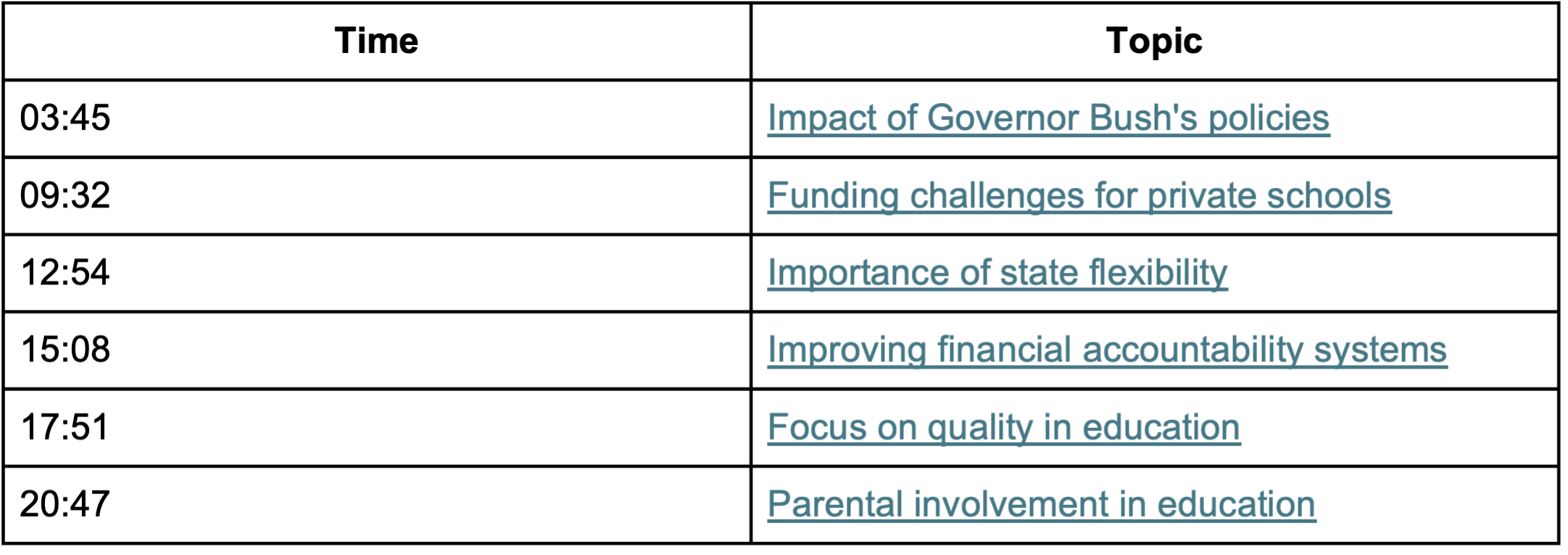
Impact of Governor Bush’s Policies
Ryan Delk
And so, we sort of experienced, you know, what I think of as the before times and it was very contrarian. We got a lot of questions. I think she was frankly judged by a lot of people, you know, for, for doing what she did. And then when Governor Bush took office, he, you know, sort of decided to, to go to the mat for, you know, a lot of these issues and make it a key priority. And so we, we actually sort of experienced the shift where it was, it was you know, not only just normalized but sort of like celebrated and empowered. And so I now feel this frankly like a real weight and responsibility as sort of the first generation to benefit from these policies. And then now, three decades later, you know, getting to spend my life building schools like this that open up those same opportunities to students with the same, you know, structure and work that, that not only, you know, Governor’s administration, but many, many folks since then have carried the torch to unlock these opportunities for kids. And so the weight of that is not lost on me.
And I think it’s quite powerful that we’re sort of seeing the second generation now. The folks that had the, that got these opportunities from, from sort of generation one of these programs now being able to reinvest in the next generation is, is quite exciting.
Michael Horn
Well, and it’s fascinating, right, that narrative of ostracism almost to norm, to expectation, right, for families. And as I understand it, you all at Primer are thinking a lot about the policy and regulatory landscape and some of the critical questions when it comes to things like microschools and the like, zoning, fire safety codes, things of that nature. I know there have been some big developments over the past couple years in Florida around some of those zoning questions. Can you just update us both on what’s happened, but also why it matters so much?
Ryan Delk
Yeah, so we are, we’re one of. There’s a lot of people doing great work on this Excel in Ed. There’s a ton of great, great orgs. And so we are one of many people that are working on this issue. There is one, you know, very narrow and perhaps, I think, very underrated, but maybe, you know, kind of unexciting part of the regulatory landscape that I happen to care a lot about, and that is the regulations around new school supply. So there’s an enormous amount of energy that’s gone into what I would articulate as the demand side, unlocking funding for parents, making sure that the funding follows the student. And that’s, you know, as we discussed, many decades in the making. But now that that exists, the reality is that a lot of the regulations around starting new schools, and I learned this firsthand, like the amount of nights and weekends that I spent early on at Primer staring at zoning maps of cities and counties is far more than I ever anticipated.
And the reason for that is that there’s all these regulations that sort of, you know, take as a sort of starting assumption that every school is still a, you know, 60,000 square foot, $30 million build to serve 2,000 students. And so in that framework where every single school looks like that, of course there’s traffic studies and school bus parking and very intense building regulations, that all makes sense in that context. But now in this world where you have a great educator who wants to open up a school in a church or a community center or, you know, a facility like this, those regulations are quite arduous. And they’re arduous, you know, we’re a fairly sophisticated operation. They’re arduous at times for us, but, but in many ways they’re impossible for like a sort of seasoned educator that wants to go serve their community. And so what I care is the sort of common sense, right sizing of these regulations specifically for small schools.
So for the large schools, a lot of what’s in place is, I think, serving that need really well. It makes a lot of sense. But for small schools, we want to make it much easier for those schools to open up in existing facilities to serve their community. And the reason that I care a lot about this is that I’ve seen firsthand stories of dozens, maybe hundreds of educators who want to start not just primaries, but all sorts of types of schools who reach out to us and say, hey, I got stuck. I have, you know, I’m trying to get this building permit, I’m trying to get this code, I can’t figure out zoning, or I’ve got to do a nine month variance process. All these things that are sort of just, just incredibly arduous for the task at hand. And so we spend a lot of time and a lot of energy from a legislative perspective making sure that we can knock down those barriers.
Michael Horn
Governor, I want to broaden the view now beyond Florida and think about these sorts of questions, supply questions, others, in the context of this sort of nationwide movement right now we’re seeing toward educational choice. And I’m curious both of your takes on a couple of items that we can run down. First, it strikes me just thinking about what you said on the zoning side of it. As an onlooker, there’s a pretty robust demand right now for different options that meet different kids needs. But the supply side that you just described, so you’re taking some significant steps there, but getting a sustainable supply side that’s affordable, low cost, private schools like Primer. What’s holding up the supply side? What else should we be thinking about in terms of that? Or maybe my perspective is wrong on this, but I would love to think about how do we really encourage this robust supply side.
Governor Bush
Ten years ago the big fight was how do we get charter schools to be able to access, as public schools to access public capital, what we call in Florida pico dollars. And that was a struggle because look, the public schools feel threatened by all these choices. I mean my, my hope and dream is that there’ll be a superintendent in Miami Dade county or some other place that says every child that goes to school in my county is my responsibility and I’m going to create a menu of options for parents and I’m going to try to do everything I can to make sure that every child succeeds.
Michael Horn
So really helping them navigate to the right option.
Funding challenges for private schools
Governor Bush
Yeah, but if you had that attitude, you wouldn’t be, you know, making it impossible for a private school to get a permit or you wouldn’t have, you wouldn’t restrict private capital to come in. I mean, there’s really one institutional source of money for private school capitalists, the Drexel Fund, which is for Catholic schools. The charters have, you know, three or four fundraising operations for their capital growth needs. So that’s part of it is you need to have more private philanthropy come in. But ultimately this should be a state responsibility as well. I mean, do we, do we do this in Medicaid? Do we have government run doctors and government run nurses and government run clinics? Some, but it’s not the dominant way that someone that is qualified for Medicaid gets access to healthcare. We should have the same mindset for education. And I think you would have an acceleration of really interesting options both in terms of hybrid learning, you know, where a parent could choose to take care of many much of their healthcare, their education needs, or they could go to Primer and take some of the money maybe and go to do something that accelerates the learning.
This is where we’re moving and there’s still, it’s work in progress. But I’m really excited that Ryan and others like him, education entrepreneurs, are advancing this at a pace that’s pretty exciting.
Michael Horn
Ryan, what’s your take on this in terms of the sustainable supply? What’s it going to take to get supply to meet the demand that we’re seeing?
Ryan Delk
I think it’s all about cost. And we have this core value that acts as the constraint. And so we start from the place of Primer needs to be accessible to every family, regardless of income. We’ve never turned away a student. And so some of the regulatory work that we’ve discussed that to me is all connected to this idea of how do you get these schools open as efficiently as possible and then how do you get the cost to educate down where parents can attend these schools for ideally nothing. Ideally it’s completely free. They just use their ESA and they can just attend the school. But if there is some out of pocket, it’s 50 bucks a month or 75 bucks a month.
And to me that is the key thing to unlock because then these scholarships are accessible or they’re unlocking opportunities for the families that need it most. The families that can afford a $15, $20,000 a year school, they don’t necessarily need these options as desperately as the families that are trapped in schools that are not serving their needs. And so that’s what we’re obsessed with. And I think there’s a kind of growing coalition that’s really focused on this low cost, high quality private school.
Michael Horn
Second thing I’m curious about, and we’ll go to my inner wonk here, your inner wonk here, which is there’s been a big proliferation of education savings accounts across the country right now. But there are subtleties in the policies in different states and I’ll just name a few of them because I’m curious what you all think about the impact of these differences. I’m thinking of the increasing number of states with accreditation requirements for example. Florida, you know, does not. You have some states that require external assessments of students in these low cost private schools. Some don’t. Some states are tuition first ESAs and some are not. Some allow you to roll over dollars even for post secondary education.
So it really creates a savings and value ethos as opposed to others that are not. We in the media often call these all ESA states. Are we sort of masking over these subtleties? Do they matter, the variants? Are we lumping them sort of at expense of understanding what we’re really trying to create here? What’s your perspective on these differences?
Importance of State Flexibility
Governor Bush
My perspective is that’s all good. You know, if we had one size fits all, it’d probably be driven out of Washington and that would be. It wouldn’t happen. It would be an unmitigated disaster. So having states have the ability to implement as best they can a version of ESA and then modify it as they go along because someone from another state’s done something interesting like the education savings account where you can reinvest it if you didn’t spend the whole amount. I mean that’s an interesting idea that may catch on for all the states that don’t have it now. To me I think the baseline should be there’s a financial responsibility that if you’re taking taxpayers money directly or indirectly, you should be a good steward of that money. And there’s health and safety issues that are really important, particularly for young kids. Beyond that, let’s let a thousand flowers bloom and come up with the best approach.
The important thing is that we get to scale so that parents demand that no one tries to take it away. That’s the first mission and that’s happening. You know, if 50% of all kids in Florida parents choose, it’s going to be hard to imagine if someone wants to come and try to re regulate this and have it just be traditional schools being the only option. I don’t think that’s going to happen. Texas, you know, having a hundred thousand kids to start with and over time that growing is going to create another kind of scalable moment for that state. And so if you try to impose a bunch of rules on top of that, it’s not going to grow at the speed that I think will make it more effective.
Michael Horn
Ryan, what’s your take on the variance?
Ryan Delk
I mean I’m a personal big fan of federalism so I just have a personal bias towards that. But I think what I’m encouraged by is the movement is coalescing around the right things. And so when you look at the programs that have launched recently, they have measures to make sure that the providers are delivering for students, they’re fiscally responsible, the dollars are flowing to low income, working class, middle class families that need them. And so I’m really encouraged by the way, I think the last four programs that have launched at scale have all had versions of that in place. And I think if that’s taking the best practices from other states, implementing them into new programs and if that continues then I’m quite optimistic.
Improving financial accountability systems
Governor Bush
You know, one of the things that could be done in a federal system and it’s happening right now and ExcelInEd is working on this is to create a coding project because right now the technology isn’t the same as it would be for a health savings account for example, or think about your MasterCard or Visa. All this stuff is done, you know, we have no clue how it, at least I don’t have any clue how it works, but it works really well. Whereas if you think about all the coding that could happen to make sure that there’s financial accountability and also that parents aren’t out of pocket making these commitments that they don’t have the resources to do because of some bureaucratic snafu at the state level. So there are things that could be done, but those are more like private sector enhancements that will make this more effective.
Michael Horn
And I guess it also helps the supply side so that those dollars actually reach the operators. Right. Ryan, you’re not sitting there waiting for it. Let me ask, Governor Bush, if we zoom out, what do you see as the big flashpoints to come in educational choice? It could be Florida, but also nationwide.
Governor Bush
Well, you can see it happen if there is, I’ll use Florida as an example. We have several hundred thousand, we have half of all the ESA kids are in our state. So you could have 1/10 of 1% of those transactions take place in a way that is inappropriate as they’re trying to sort out. You know, you’re dealing with scale, it’s hard to do all that. And so then you know, Senator Schmidlap will want to say well we need to like regulate this and regulate that. That’s the biggest danger is Washington getting involved or states trying to re regulate to deal with the tiny fraction of problems that impacts 99.9% of families. So regulate in terms of testing. We should trust parents to make these decisions and then give them the tools to be informed consumers and give them an array of choices.
And we need to protect that. That to me, you can see this happening at the state level. New governor comes in, they feel compelled to do something. And I’m very fearful of Washington getting involved. I’m excited about the tax credit program, but I haven’t seen the rules. And, you know, I’m paranoid about this stuff because I’ve seen there’s too many examples of Washington with good intentions getting things wrong.
Michael Horn
Ryan, I’d love to hear your reflections on the big flashpoints of the moment and both to comment around what the Governor just named, because you’re operating not just in Florida. So what are you seeing as those big questions or big issues that the field’s going to really have to think about or protect against in the years to come?
Focus on quality in education
Ryan Delk
I mean, I think a lot of people care a lot about education in this country, and that’s a good thing overall. And so there’s, you know, people with strong perspectives on both sides. A lot is changing. The world is changing really quickly. And my view on this is there will continue to be flashpoints, there’s going to continue to be contentious policy debates and accreditation and testing and all these things. But I really believe, I have deep conviction that if we stay focused on delivering high quality academic outcomes in a way that’s accessible for every family, that that is the winning strategy. And if we can stay laser focused on that and all the inputs to that, from, you know, great rigorous academics to unlocking the regulatory environment for new schools to open, to empowering educators to serve their communities, if we stay just maniacally focused on that, I think everything else falls into place. Because when you unlock those opportunities for those kids, and it’s not just that family that becomes a huge advocate for this movement, it’s their city council member, their city commissioner, all these people start to see, wow, this is transforming this community.
And when you do that, I think that is the winning focus. And so I hope that that can be the thing that we all rally around. And obviously these flashpoints will continue to happen. But that’s what we’re focused on. We’re going to stay maniacally focused on that. And I think a lot of other folks will too.
Michael Horn
I was curious about the assessment piece of this.
It seems this is much more of a trust the parents accountability model model that you’d sign up for as opposed to with traditional public schools. Let’s test. Is that accurate?
Governor Bush
It’s accurate, but I think parents, most states do have norm reference tests as a measurement of how kids are doing. And if you want parents to be empowered to make these choices, they need to be informed about the caliber of the education. So I personally support the idea of norm reference tests, and that’s the norm across the country. But I’m respectful of places like Arizona that, you know, want to have a little more libertarian approach. It seems to work well there, and maybe it’s part of their culture, a little bit more of their culture than it is in another place in the country.
Michael Horn
Final word. Governor, as you reflect over a quarter century of publicly funded choice in Florida, and we sit in a school that probably could not have existed, serving the students, you know, that could not have been in such an environment before if it weren’t for these policies that you started to put in place. What are your final reflections?
Governor Bush
Look, when you get a chance to serve, it’s really cool over the long haul to see successive legislatures and Governors embrace this idea and build on it. And I’m proud that our political leadership over the last 25 years has accelerated this. And my hope is that it stays the course. Look, big ideas take a long time. You could be patient. You got to be stubborn. In some cases you can. You just, you gotta, you know, stick with it.
Parental involvement in education
Governor Bush
And in Florida, that’s the case, I don’t think. And I would say there are external issues as well. If we didn’t have Covid, which allowed parents to really realize that maybe their kids weren’t getting the education that they thought they were getting because they became the teachers of their kids and they saw the slop that many of them sadly had to deal with, that accelerated it even more. So I’m excited about this. I think it’s really important that we stay the course because the world we’re moving toward at warp speed is exciting, but it’s also really scary. And you want to make sure that kids can read at the end of third grade in a capable way so that they can learn in a dramatic way, and that parents know what’s best for their kids to make the right choices. And there’s an array of them. That’s the mission, and it seems to be doing quite well right now.
Michael Horn
Governor, Ryan, thank you so much for joining me in this conversation.


