


Ryan Delk, the founder of Primer, an innovative K–8 private school network focused on accessibility, mastery, and student agency, sat down with me at a Primer school in Florida to help me learn about Primer’s schooling model.
Ryan explained how Primer partners with passionate educators to launch flexible, community-focused campuses that prioritize affordability and transparency for families. Our discussion showcased how Primer leverages technology to personalize academics through regular assessment, supports teachers by reducing administrative burdens, and cultivates real-world skills and student empowerment through project-based “pursuits.” And we have clips throughout of teachers and students interacting in the school, as Ryan gave me a tour of the school. I can’t wait to hear all of your thoughts in the comments.
Michael Horn
Welcome to the Future of Education. As I’ve discussed, for the last decade-plus, we’ve seen a wave of microschools and, more accurately in my view, low-cost private schools, emerge across the country. Many are local schools with one or two sites. But a few have scaling ambitions through different mechanisms—names like Acton Academy, Prenda, OpenEd, Wildflower, KaiPod arguably, Flourish, and a few others. And then there’s another school network with such ambitions called Primer. I had long heard about the Primer model from many folks and knew several of the team members. But I had never had the opportunity to visit a Primer School. Knowing I would have the opportunity to interview Gov. Jeb Bush and Primer’s founder, Ryan Delk, in Florida at a Primer School, I was also excited to visit and learn more about the model.
What follows is some of the conversation Ryan and I had and a look into the school itself. For those listening, you’ll miss a lot of the video of the actual schools but you should be able to get the basic flavor. For those watching, I hope you enjoy and learn from the accompanying video of students and teachers.
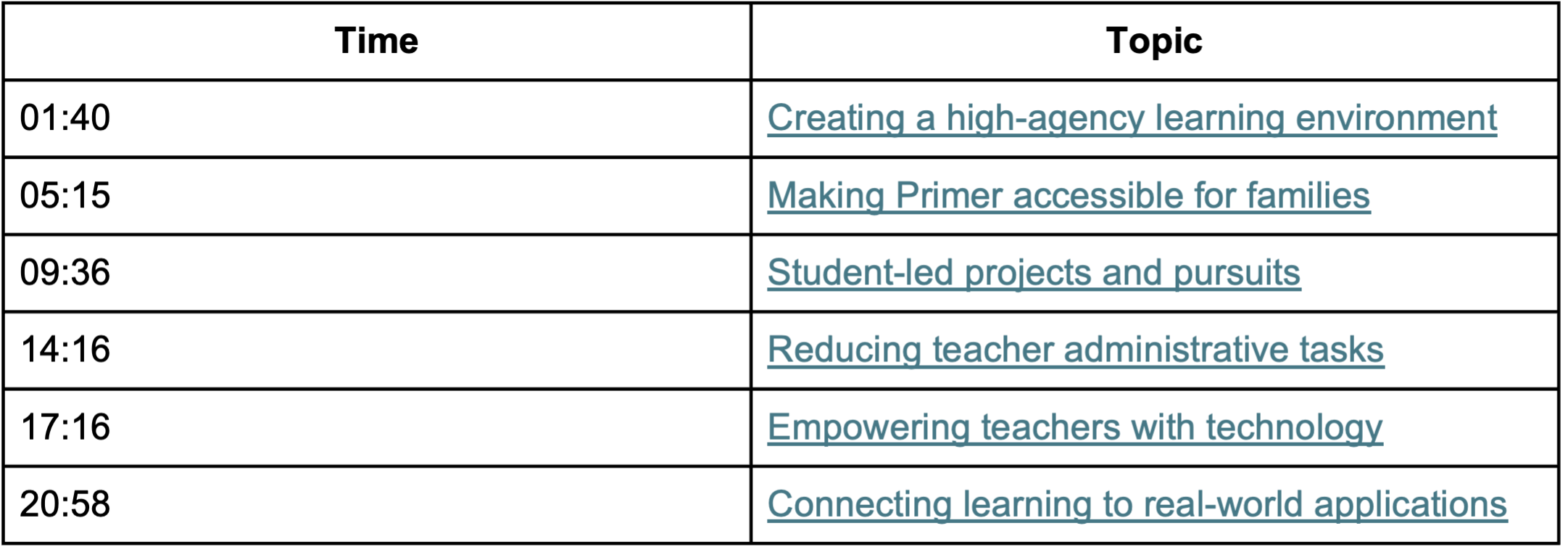
Creating a high-agency learning environment
Michael Horn
Ryan, I’ve been wanting to see a Primer school for I don’t know how many years now. We’re here, we’re here at Coconut Grove. Tell us about the Primer model. That’s the first thing I always hear when I hear about Primer schools is you have to understand the Primer school model. What is it?
Ryan Delk
So it’s, I’ll talk about it from the family, teacher and student perspective. So from an educator perspective, Primer exists to empower these great educators who have dreamed of starting a school or want to start a school and want to serve their communities. But that’s a quite arduous process if you want to get a school ground. And so we partner with these great educators, we help them open these schools across Florida, now Alabama, soon Texas. And these are sometimes former administrators, they’re sometimes longtime teachers, sometimes Teach for America alums. But they’re people that see that the traditional system is not meeting kids needs, not meeting the needs of their community. But they really care about figuring that out. And so they, they, they partner with us to open, to open these schools.
From a family perspective. Most of our families are in some sort of school situation that they know is not meeting their needs. And they’re typically not the families that can afford to move to a private school. These are really mostly working class, middle class, sometimes low income families that really care about their kids’ education. They’re deeply passionate about this. They believe in education as a driver of upward mobility and the importance of it. But they know that the current setup is not meeting their kids’ needs. And so they seek out Primer.
They’re able to attend Primer often for free or for a very low tuition cost per month. And then from a student perspective we really believe in this idea of taking kids seriously. That’s like our sort of North Star from a student experience. And so we’ll talk more about that and I think we’re going to go, go see some kids in action. But this idea of when you create a high agency environment for a student and specifically around academics, you give them transparency into exactly where they’re at. Are they above grade level, behind grade level? And so parents, teachers, students, everyone can see, okay, I’m a grade level ahead in math, I may be a grade level behind in reading. Here’s the game plan. You give them agency over, you sort of give them the opportunity to get, to either get farther ahead or to get onto grade level.
And so all the software that we’ve built that powers the school day, is really sort of built with that in mind. And so you have this high agency environment for kids. You have teachers who are really excited about serving their community, and then parents that are motivated to find a better option for their kids.
Michael Horn
Maybe let’s back up before we actually get to see what that all looks like and just how many schools are in the network? Like, you’re one of a handful of networks that I think of going to scale right now with your model. How many are there? How many students in a school? Like, give us some of those fundamentals, if you will.
Ryan Delk
Yes. We have 14 campuses across Florida, Alabama and Arizona. We’ll be launching a handful in San Antonio this fall as well, and a few more across Florida. And the average campus is anywhere between 50 and 120 students, depending on the real estate. So it depends on the campus setup and the number of teachers, et cetera. We will open Primers, our model is intentionally flexible from a real estate perspective. And sort of the controlling variable for us is access and cost.
And so we have this core value of access as the constraint. And so we start from that place and then we figure out how to deliver a really high quality education in a way that’s accessible for every family. And so we open Primers in spaces like this. We’ll sometimes partner with churches, community centers, charter schools, some property developers, residential developers that want to bring a Primer to a residential community. We’ll do a lot of different things to get Primers off the ground and do it in a way that’s as affordable to every family as possible.
Making Primer accessible for families
Michael Horn
When you say affordable, like, what are we talking about tuition levels and how are, you know, families here? How are they paying?
Ryan Delk
I think we, I mean, you would maybe know this. It’s hard to know for sure. I think we might be the only private school network in the US that lowered tuition for the majority of our families last year. So the majority of families are paying less for Primer in School Year 25 than they were in School 24. Okay. And my hope is we can keep doing that for a very long time. We’ve never turned away a child for their family’s ability to pay.
So if a family comes to us and says, hey, I really want to attend Primer, but 50 bucks a month is too much, like, we will always work with them. We have the Primer foundation that unlocks scholarships for those kids when they need it. And so, so we are, we are really serious about this idea of making this accessible to every family. And then for the families that do pay out of pocket, in addition to their state ESA, they typically pay between $50 and $200 a month. Most families, it’s a sliding scale based on income. And then in some states like Texas, it’s 100% free. So it depends a little bit state by state. But my vision very explicitly is to get Primer to be 100% free or ultra low cost.
Some states require some small amount out of pocket, but ultra low cost for every family that attends. And that is, that is our North Star.
Michael Horn
It’s interesting. Purdue University in the higher ed space got however many plaudits for holding tuition level. You’re lowering it. That’s truly unique, I think. Talk to us about, you know, sort of the day in the life of a student. Right. Are they coming five days a week? What sort of the arc of their day looks like?
Ryan Delk
Yeah, something we believe that’s really important for these kinds of quote unquote alternative education models. We really want Primer to feel legible to parents, sort of legible to the existing system. So it feels like a school. So we operate from 8 to 3 or 8 to 3:30 every day. Students come five days a week. And so when you’re here, it feels fresh and it feels new and exciting and different, but it still feels like a school. And that’s really important to us. And so for parents that are working that, that, you know, are thinking in terms of a traditional school schedule, Primer fits, you know, exactly what they would expect.
The basic day breakdown, and we’ll see some is in the morning, kids are working on core academics. So all core academics at Primer are individualized for the student. And so they join Primer, they take a nationally normed reference test, the NWEA map test. We get a snapshot of where that student is academically. Every student is. There’s no student that is perfectly at the exact same grade level in every single subject. And so we get a snapshot of this student is maybe half a grade level ahead in math, half a grade level behind in writing, on grade level in reading. And then the system builds an academic model for them.
And that academic model includes direct instruction from the teacher. So there’s, you know, moments during the day where either the teacher has a small group of students or she’s doing group instruction. There’s also moments during the day where the students might be learning from a virtual instructor. So let’s say they need remedial support in reading. They might be in a remedial math or reading class with another small group of students across the Primer network, virtually with an expert tutor that’s helping them accelerate back on grade level. There’s also points in the day where the student might be working on a learning app or software tutor. Some of the students that are really far ahead, that have mastered concepts and can move quickly.
Some students that might need, you know, very specific targeted instruction to a specific concept. And then the fourth sort of modality is students working together. So it might be students reading a book together, discussing it. We really want students to learn this idea of the sort of, we can call it learn how to learn, but this idea of them being able to take agency and ownership over their education even at a very young age and not need a teacher hovering over them to make sure that they’re doing their work, but be able to sit in a group of students and have a robust discussion and understand that they have the freedom to go do that, but also the expectation that they stay on task and, you know, have a fruitful discussion.
Michael Horn
And then. So that’s the morning block, basically, these fundamentals of all the subjects, I guess, reading, writing, math, science, et cetera.
Ryan Delk
So, yeah, so science, social studies, history, those happen in the afternoon through pursuits. And so pursuits are sort of are you think of it as i t sort of accelerates over or becomes more robust as kids get older. But we want to figure out what makes every student tick, what are they excited about, what are they intrinsically motivated, and then develop a set of projects that they can work on that align with those interests. And so when kids are younger, you know, these are group projects like, let’s build a community garden. Let’s, you know, learn about local politics and, you know, how a new law is going to, you know, become law in Miami Dade County.
Student-led projects and pursuits
Ryan Delk
These are projects that the primary leader is usually kind of facilitating as a group, but as kids get older, it turns into, let’s start a company, let’s go work on a microbiology research project. Let’s launch a podcast, you know, let’s publish a book on Amazon. And then we have a team that works with both the students, students and the primary leader to set academic milestones for against state standards, against different gaps that the student might have that weave into that project. And so we really want the pursuits time in the afternoon, from a parent perspective, to almost feel like something that you would expect to be paying for as, like, enrichment or after school. But it happens during the school day. And then from a student perspective, this is when they learn that agency and that sort of, you know, by the time they’re in sixth, seventh, eighth grade, it’s, hey, this is, you have two hours today.
How are you going to use that time? Are you going to hit your goals? These are really important skills that they learn. And they’re also getting, you know, these academic milestones, plus the ability to work on these projects they’re excited about.
Michael Horn
And this is a K through 8 model. Right. So it’s those early years and sort of this arc of having more and more agency and into these maybe bigger projects as they get older. And then you mentioned your tech system. So you take the NWEA map in the beginning, it sort of maps out this, what your academic plan is going to look like, how are you measuring mastery and then sort of pulling that back into the system to right size that educational experience. Because I’m assuming not all the kids are moving at the same pace and so forth.
Ryan Delk
Yeah. So this is probably the thing I’m most excited about that we’re building. We actually just shipped a new version of Academic Progress last week. But the basic idea is we want every teacher, every student and every parent to be operating with the same. There should be no information asymmetry. They should have the same fidelity on how a student is doing. And so we show the parent in our mobile app, on their desktop view every concept, every academic milestone, every concept, every state standard, depending on where they are for that child’s education, exactly where they are, whether it’s on grade level, ahead of grade level, at grade level, and exactly how they’re progressing. And we actually project into the future and say, okay, your child is, let’s say it’s a fourth grader that’s a half grade level ahead in math, by the end of this school year.
Here’s exactly where we expect them to be based on their current learning velocity. Or let’s say that it’s a child that’s a grade level behind in reading, based on their current learning velocity. Here’s where we think they’ll be by the end of the school year. And if that says, hey, they’re going to be caught up, that’s really exciting. If it doesn’t, then we’re going to work with that child to set more aggressive goals and the Primer leader is going to be involved in that. They’re going to do that every session, every five weeks and the parent’s going to see that, the teacher’s going to see that, the child’s going to see that, and then it sort of incentivizes them to want to work harder to get on grade level. And so the transparency and fidelity is sort of key to the whole way we think about mastery. And then the actual data itself is coming in from a variety of exit tickets.
Virtual instruction for students that might be behind, direct instruction from the PL and their notes, learning apps, like they could go on Khan Academy and take a quiz or Newsela or Frax or different applications we use. And so our system ingests all of that.
Michael Horn
So basically, lots of measures of assessment, lots of measures of mastery, and you can almost triangulate. Do we really figure out has this kid really mastered?
Ryan Delk
Exactly. And the thing, you know, the number one thing that alternative schools or whatever you want to call them like to do is come up with these kind of like internal metrics for academic outcomes that are, you know, sort of a black box and sort of shun, you know, third party nationally norm testing. And what we do is we take the NWEA map three times a year. And what that does, and, you know, parents get that data, teachers get the data, students get the data. And what that does is it keeps us honest. And so we have this.
Michael Horn
You’re looking at your internal metrics and does it line up?
Ryan Delk
Exactly. So we have daily information on every single student, that every individual Primer leader has a dashboard view of their classroom that sort of aggregates all the student data. Every campus leader has a view of all their classrooms at their campus. And then our academic team has the view of the whole network and they can drill into any campus, individual classroom and an individual student. And then we look at the map data and make sure that it correlates with what we expect. And so we can actually project what we think the MAP score is going to be for each student based on, you know, their learning velocity. And then of course, when those things are, you know, not tied, we adjudicate like, okay, was the kid sick when they took a map test? Did they not sleep well the night before? Like, we’re, we’re sympathetic to those things, but it creates this, I think, very robust picture of how kids are doing academically. And this is, I just think it’s really, really important as part of this kind of low cost, high quality school movement, to be honest about, like, we have to deliver academic outcomes for kids and not shy away from that.
Michael Horn
And not shy away from it. Everyone is buzzing about AI as, you know, what’s the role of artificial intelligence in what you just described or what you’re developing.
Reducing teacher administrative tasks
Ryan Delk
I’m more excited in the short term and this is a bit of a hot take of how AI impacts the kind of administration. So maybe just zooming out like what I aspire Primer to be for an educator is that we take on all of the sort of crufty bureaucratic administrative junk that you have to do. You know, we’ll talk to educators who say like look, I spend like two hours on the weekends filling up paperwork for different students, like all this crazy busy work. And so I don’t, I don’t know that any Primer leader has ever filled out a piece of paperwork ever. Like I think it’s just all abstracted away for them. And so that is extremely important to us. And so a lot of the ways that we’re using these new models is in empowering the teacher. Like if you think about a teacher’s day, my mental model for this is that you want to maximize the number of minutes where that teacher is doing what only they can do, which is engaging with a student one on one or in a small group or the whole class, investing in a kid, building a relationship, building trust, helping them through some really important learning unlock and when they’re tied up thinking about schedules and rosters and who’s out sick today and all those things, all that takes away both from like a cognitive load perspective but just literally from like a minutes in the day perspective.
And so a lot of what we’re doing right now is on the teacher and the parents side creating more robust visibility. But we will test and we will deploy all the latest technology for students. And so we don’t shy away from that. And so if the team will find some really exciting new math AI tutor and we’ll go, if some students want to try it, they’ll try it. We’ll look at the data, we’ll look at the learning velocity. We actually just concluded one which I won’t name here, but didn’t beat the current system. And so we said hey, we’re not going to deploy this. And so it’s not that we’re sort of shying away from the student side, but it’s just that I think my current view is that the underlying models have gotten to the point where they can deliver incredible academic outcomes, but the sort of packaging of it in a way that is accessible to students, that’s multimodal, that meets students exactly where they are and then importantly that creates on the back end has the data architecture to be able to map whatever’s happening in the AI tutor to state standards to learning outcomes.
That is still quite messy, but I think we’re like three to six months away from that. And sort of the whole point of the software, or a significant point of software we built is to ensure that we can plug in those best in class tools and deliver for kids when they’re ready.
Michael Horn
Well, something that seems distinct about your model compared to a lot of the other models I see and hear about right now is that rather than saying we’re going to sort of reduce the number of inputs into a kid’s education, you’re basically saying flowering. If a teacher one on one or in small group with you is the best modality, great, we’ll take that and ingest the data and figure out did you master it, if it’s this software program, if it’s a tutor, whatever it is, and basically the system is sort of taking all these inputs and refereeing or sort of coming up with a picture of mastery. Talk about that philosophy. Because that does seem distinct, I think.
Empowering teachers with technology
Ryan Delk
Yeah, there’s two things that I would say. One is we are big believers in the educator and the teacher as a sort of sacred part of a child’s school experience. I think that’s true for any kid. I think it is especially true for children increasingly that come from one parent households or situations where their home life might not feel as stable. Teachers provide a really important role for those kids, far beyond just the education. And so this idea that like AI is going to replace every teacher, you know, we sort of reject that future. And I care much more about how do we empower teachers to do exceptional work to build these relationships with kids to be, you know, how do you take a, you know, 75th or 80th percentile teacher objectively? And how do you, how do you make them a 99th percentile teacher? How do you give them superpowers? By taking on all this admin work by, you know, we’re starting to do this, this thing called alerts where a teacher can get a ping in real time when a student is struggling with a specific concept. And so imagine a 99th percentile teacher is sort of constantly keeping in their head where each student is, what concepts they’re struggling with and knows when to sit down with them one on one and grab the scratch paper and intervene.
Well, what if the software did that for you and said, hey, this student right now in real time, 10 seconds ago was struggling with 3 digit subtraction. I think it’s a really high leverage moment for you to grab some scratch paper and dig into this. Yeah, that’s the kind of thing that we get really excited about. So we’re, that’s sort of our vision for the future. And then I think from a, from a sort of modality perspective, we care a lot about ensuring that what we put in front of kids and the way the school day is structured meets our internal bar for delivering academic outcomes. And so we’re very thoughtful about screen time, we’re very thoughtful about the technology the kids are exposed to. We’re very thoughtful about what we ask of teachers. And so it is, we’re sort of, we’ve built the system to be highly flexible around the best in class tools, but we still have an extremely high bar for what makes it in and what students are exposed to. And that will never change.
Michael Horn
So we’ve talked about how you measure the fundamentals and mastery around that. You’ve talked a lot about the importance of agency and these other habits or skills right
That is going to serve students not just in school but throughout their lives as they try to live choice filled lives. Yeah. How are you measuring and looking at that? Right. Because that seems like an important piece of what you’re doing.
Ryan Delk
Yeah, we think of those as like the inputs to, you know, there’s academic outcomes and then there’s the inputs to academic outcomes. And so we call them habits of work. And so every time a kid engages, a student engages with a pursuit and other parts of Primer, they know that the habits of work are really important input into the score that they get or the grade that they get. And so, you know, these are things like, you know, is the child showing up engaged? You know, is the student working hard? Are they, are they hitting their goals? Do they have legible goals? And I think that piece of it, I think is an underrated part. So people are focused on the outcomes. What’s the MAP score, what’s the grade levels, gpa. But we care a lot about these inputs, one because I think they are inputs to academic outcomes and they’re important.
But to your point, if you’re launching a Shopify store as part of your pursuit, learning how to show up even if you didn’t sleep well the night before and be focused and work hard for 45 minutes or an hour on that is a really important life skill. And if you learn that in sixth grade, that’s going to pay dividends for you well into adulthood. And so we think about them both because they’re important for academic outcomes, but also because they’re just important for life.
Michael Horn
And it’s the context in the academic outcomes. What’s the connection between, I’m learning the fundamentals of English, math and so forth, and then I get these projects in social studies, science in the afternoon. Is there a connection? Do the students say, like, hey, I’m learning reading so that I can do this thing? Like, do they understand that connection?
Connecting learning to real-world applications
Ryan Delk
Yeah, we had a student. So yes, the high level sort of answer is that we want students to feel a direct connection between what they’re learning academically, unlocking these cool projects that they’re excited about. And the, the point of that is, you know, eventually it’s grows to, okay, I’m gonna go study this thing for four years in college and then go become this, you know, or I’m gonna go to trade school, learn this set of skills and then go, you know, have this profession. And so this, this starting to sort of develop the pattern matching of hey, I can learn this thing in school and then it unlocks this project for me is really important. But what we, what we try to do is we try to both, both have that happen kind of fluidly and natively within the projects, but then also explicitly create that. And so I think last year we had a student that was really interested in statistics or, or math, and they’re really excited about the NFL draft and like how teams were going to, you know, were going to be able to decide who they were going to draft and relative to their current roster and salary caps and all these things. And so I was able to connect her with an NFL team. And we, you know, we were on FaceTime, talking to them about who they were going to draft and why they were going to draft them.
And that was like a very, you could tell, the kind of like, eureka moment for her of like, okay, I learned this math, and then I was able to use that math to create this sort of view of what the optimal strategy would be for a draft. And then I actually got to talk to an NFL team about it and have a conversation. And that’s just like a very, very small anecdote. But those are the kind of connections that we want to make for kids. And I think that if we do that, especially fifth, sixth, seventh grade, that’ll pay tremendous dividends.
Michael Horn
That’s real empowerment.
Empowerment indeed. I hope you enjoyed this special edition of the Future of Education as much as I did. Being able to be in a Primer school with the students and teachers live was just a huge treat. So a huge thank you again to Ryan for joining me, and a huge thank you to the whole team at Primer and all the supports behind them that helped make this visit possible. There were a lot of logistics to make all these things come together and they just were absolutely top flight professionals in making it happen. And a huge thank you as always to all of you for joining this special edition. I look forward to hearing about all your reactions and thoughts and comments to the episode. And as always, we’ll see you next time on the Future of Education.


