


A week ago, Angela Jackson (the CEO of Future Forward Strategies), Mallory Dwinal-Palisch (the President of Craft Education, a WGU company and nonprofit data platform that enables apprenticeship degrees), Danny Curtis, and I published a series of six papers that together offer a state policy playbook for building integrated education-to-career systems. You can download and read them all at the Clayton Christensen Institute here.
Today, I’m distributing the second paper below on my Substack. This paper provides the playbook for how states are supporting K–12, higher education, and workforce agencies in creating a common understanding of the current system, the future state they are trying to build, the changes required to get there, and the progress they are making toward those changes. One note: citations and author bios are in the original PDFs themselves at the Christensen Institute.
The shift required to prepare learners for a labor market defined by rapid skill change and more complex transitions cannot be accomplished by any one system. Nor is it enough for K–12, higher education, and workforce development to improve independently. They must work together—aligning programs, sharing resources, creating smoother transitions, and building models that combine academic learning with real workplace experience. Career readiness is not simply a goal these systems share. It is a shared outcome that they produce together as parts of a single talent pipeline.
For that reason, the first priority for states is not a single programmatic reform. It is creating a coherent, cross-system strategy. K–12, higher education, and workforce agencies— and the providers they oversee—need a common understanding of the current system, the future state they are trying to build, the changes required to get there, and the progress they are making toward those changes.
States are often asked to create roadmaps for transformation efforts. They should do more, however. At their best, state governments should build something more akin to a GPS. A statewide vision establishes a shared destination. A coordinated statewide strategy charts the path to that destination for policymakers and providers alike. Meanwhile, shared data systems drawing from K–12, higher education, and workforce programs can help leaders monitor progress, identify problems early, and adjust course as conditions change. Together, these tools help states and providers navigate toward the future they are trying to build together.
This paper offers three recommendations for doing so, each illustrated with a state policy example:
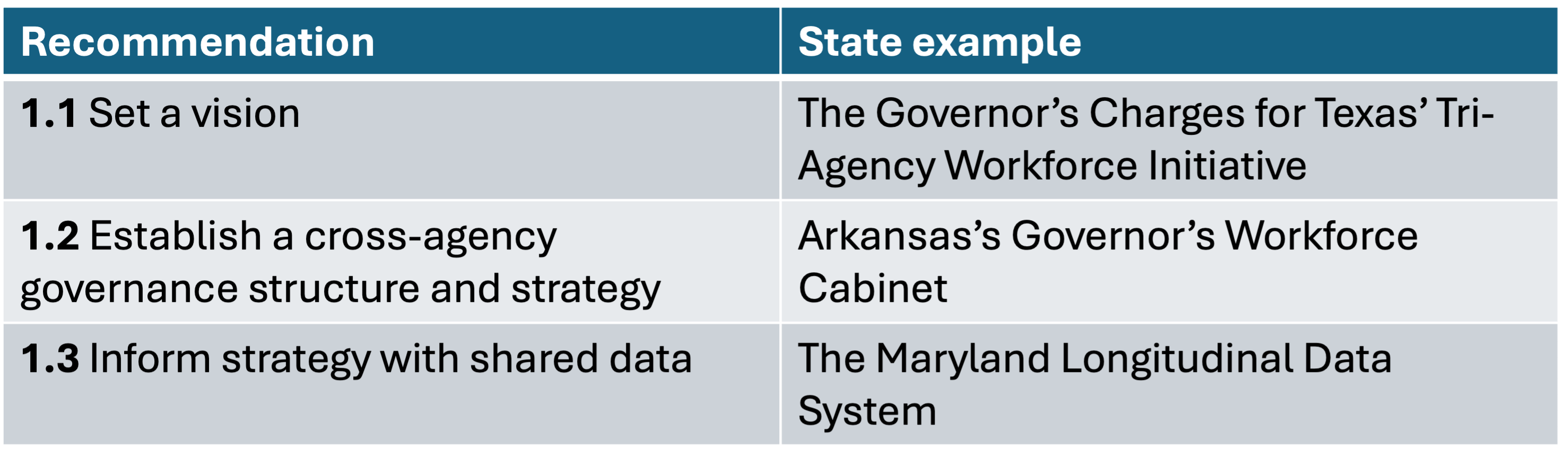
Recommendation 1.1: Create An Effective Vision For Transformation
Principal Policymakers: Governor’s Office
Every major state transformation effort begins with a vision.
A vision is not a plan or even a strategy. It is the North Star that sets the direction for those documents and makes them coherent. It helps political leaders and agencies communicate why change is necessary, what a better future state looks like, and what outcomes the system should be organized to produce.
Too often, however, statewide visions are too broad to guide the decisions that follow. Calls for “more career-connected learning,” “better alignment,” or “stronger workforce preparation” may be directionally right, but they can leave civil servants, legislators, institutions, and partners unsure what specific changes they should make. A more effective vision describes what success looks like. It shows, in concrete terms, how learners should be better served, what kinds of transitions should become easier, how institutions should perform differently, and key measures to track. An effective vision should also make clear that success means expanding learners’ choices and access to high-quality careers, with progress measured across demographic and geographic groups.” This adds an important standard for judging whether the vision is actually serving learners equitably.
The opposite mistake can be just as damaging. Some statewide visions move too quickly from setting a direction to prescribing solutions. When that happens, the vision stops serving as a North Star and starts crowding out strategy. This happens when a vision begins diagnosing problems in the current system, weighing tradeoffs, and determining the precise reforms each actor should pursue.
A useful vision must strike the right balance between the two. It should provide enough specificity to guide action, while leaving enough room for the people closest to these systems to shape strategy and implementation.
Understanding the Impact Through Business Model Theory
A statewide vision may appear soft compared with statutory or regulatory reform, but Business Model Theory helps explain why it matters. A vision signals what kinds of value propositions are desired. When articulated clearly, it also helps state agencies in the relevant value network see how their own policies, funding, and regulations may need to change so that providers can move toward the vision. In that sense, a vision can be the first move in a broader business-model shift. It does not change business models by itself. A vision sets the direction for the changes institutions need to make and for the policies that will support those changes.
Chesterton’s Fence Consideration
A statewide vision can bring greater coherence, but policymakers should first ask what the current lack of a single unifying vision is protecting. Fragmentation leaves room for education and training systems to pursue different goals. It allows institutions to balance civic, developmental, academic, and economic goals instead of reducing them all to workforce preparation. The challenge is to create a shared vision that improves career outcomes without crowding out the broader educational and public purposes that schools, colleges, and training providers also serve.
Deep Dive: The Governor’s Charges For Texas’ Tri-Agency Workforce Initiative
Texas’ workforce transformation began with an opportunity. In 2016, the state projected that its young workforce would grow by tens of thousands over the following decade. State leaders recognized that this youthful population could become an enormous economic asset—but only if Texas prepared those young people for the jobs of the future.
To that end, Governor Greg Abbott established the Tri-Agency Workforce Initiative in 2016. The initiative brought together the executives of the state’s K–12 education agency, higher education coordinating board, and workforce commission and issued them a set of charges that guided the work of the initiative. From that vision flowed a strategy, and a portfolio of work that advanced the progress set out in the charges.
But the first iteration revealed the limits of a vision that does not clearly define the outcomes agencies are meant to achieve. Those initial charges focused largely on activities and processes rather than an overarching, learner-centered vision. Harrison Keller, who served as Commissioner of the Texas Higher Education Coordinating Board at the time, recalled that the result was “a lot of parallel work within the agencies, but not much cross-agency collaboration to help the state move forward.” Without a clearer picture of what the agencies were trying to accomplish together, they had less reason to develop a shared understanding of the state’s talent pipeline or coordinate their work around it.
In 2020, as Texas made major new investments in education, Abbott reset the direction of the Tri-Agency Initiative. This time, he articulated a clear overarching vision: “Texans of all ages should have access to high-quality education and workforce training that empowers them to achieve their full potential.”
He paired that vision with seven new charges that translated it into more concrete outcomes, including:
Transitions: “...Streamline educational pathways, ensuring students can seamlessly transition into high-wage and high-demand careers.”
Completion: “...Students who pursue higher education and workforce educational programs can complete those programs in a cost-efficient and timely manner.”
Readiness: “...Students are prepared for future growth at each stage of the educational pipeline.”
The charges also identified policy areas and barriers the agencies might need to address, but they stopped short of prescribing the reforms themselves. The Governor’s Office defined what should change for learners while leaving the agencies room to determine how to bring those changes about.
That balance was intentional. Drawing on the experience of the initiative’s first iteration, the Governor’s Office and agency leaders sought in 2020 to “articulate a vision that would require cross-agency collaboration and coordination,” according to Keller.
The new charges gave agencies outcomes that none could fully deliver on its own, which created fertile ground for collaboration. Improving transitions from education into high-demand careers, for example, necessarily implicated K–12 schools, postsecondary institutions, and the workforce system. A shared vision therefore created a reason for agencies to move beyond parallel efforts and work together.
Since 2020, the Tri-Agency Initiative has updated its goals, refined its strategy, and advanced reforms aligned with its shared vision. Over the same period, Texas expanded dual-credit participation and substantially increased the share of high school graduates earning industry-based certifications. These trends do not by themselves establish the Initiative’s impact, but they indicate movement toward several of the outcomes named in the charges.
Operationalizing Impact: Key Takeaways For Other States
Focus on student and provider outcomes: Texas shows that visions are most useful when they describe the outcomes institutions should produce, not just the themes state leaders want to champion. By naming the specific changes in outcomes they seek for their state, governors can use their visions for talent transformation to signal the value propositions that education and training providers should offer. They can also signal how the agencies in those providers’ value networks will need to change their own policies, funding, and practices to support that transition.
Safeguard institutional differentiation: The Governor’s charges recognized the threat of consolidating authority, so it identified the barriers agencies were expected to address without dictating every implementation detail in advance. That preserved room for agencies and providers to apply their expertise, adapt to institutional differences, and avoid reforms that might unintentionally weaken existing safeguards or missions.
Start at the beginning: The charges worked because they could be translated into goals, strategy, and a portfolio of reforms. Other states should treat vision-setting as the first step toward implementation. The vision should be specific enough to support measurable goals and action across agencies, but flexible enough to let agencies determine which policies will work best.
Recommendation 1.2: Create A Cross-Agency Governance Structure To Develop A Statewide Strategy
Principal Policymakers: Governor’s Office; State K–12 Education Agency/Board; State Higher Education Agency/Board; State Workforce Agency
Even when a vision is clear, implementation can break down because no single agency has both the broad perspective and the authority to develop and execute a statewide strategy. K–12, higher education, and workforce agencies typically plan within their own silos. The focus is on the institutions, populations, funding streams, and accountability systems under their purview. As a result, each agency solves the part of the problem it can see. But no one is responsible for solving the whole problem. These limited solutions can even exacerbate the interdependent talent-pipeline challenges a state is facing.
That is why states need governance structures that bring the relevant agencies together to develop a shared strategy and implementation plan. Such a body gives agencies a place to identify the barriers to careerconnected pathways, determine which policies and regulations must change, and weigh the tradeoffs involved. Just as importantly, the body must have enough stature and authority to do more than produce a report. A written strategy becomes real only when it shapes funding, policy, program design, and actions.
Sourcing stakeholder perspectives can further expand the state’s view and deepen its understanding of how the talent pipeline functions on the ground. Cross-agency structures should establish formal mechanisms for input from learners, employers, education and training providers, workers, and community partners whose participation is necessary for implementation. That input can help ensure that strategy reflects the barriers and opportunities experienced by the people and institutions expected to carry it out.
Understanding the Impact Through Business Model Theory
When K–12 schools, colleges, and workforce training providers build pathways that span systems, they draw additional organizations into their value networks. For example, a school offering dual enrollment, youth apprenticeship, or another cross-system program must not only meet district and state education rules, but also higher education requirements, workforce regulations, employer expectations, and the capabilities of intermediary organizations. That’s a lot to navigate.
Cross-agency governance helps coordinate the organizations in those value networks. It gives agencies a way to coordinate the policies that shape institutions’ resources, processes, and funding. Without that coordination, agencies may continue reinforcing existing ways of operating even as the state’s vision calls for new value propositions.
Chesterton’s Fence Consideration
Separating governance across agencies frustrates coordination, but it protects the distinct public purposes of each. Like a unified state vision, a cross-agency body can create new risks if it centralizes authority around a narrow workforce agenda, weakens the expertise within each sector, or blurs accountability. The goal is coordination, not consolidation. A cross-agency body should improve collaboration while preserving the distinct missions, safeguards, and expertise of each system.
Deep Dive: Arkansas’s Governor’s Workforce Cabinet
In 2023, Governor Sarah Huckabee Sanders established the Arkansas Governor’s Workforce Cabinet by executive order and charged it with developing a statewide workforce and career education strategy. The goal was to guide workforce policies and better coordinate state funding and investments.
The Cabinet brings together representatives from across the relevant agencies, including leaders from Commerce, Education, Corrections, Human Services, Labor and Licensing, Veterans Affairs, the National Guard, and Shared Administrative Services. Bringing the agencies together allows the Cabinet to understand the interdependencies across Arkansas’s education and workforce systems. That gives it a stronger foundation for developing a statewide strategy. As the Cabinet’s Chief Workforce Officer, Mike Rogers, explained, “A lot of states have created these columns that make it hard to navigate. We’ve been able to really come at a high-level approach to remove those barriers and discover opportunities provides.”
Importantly, senior state leaders are supporting this approach. Because the Cabinet’s members are department secretaries, it can influence agency rules, regulations, and implementation. Reporting directly to the Governor also allows the Cabinet to turn cross-agency coordination into statewide policy.
Another important feature of the Cabinet is the Chief Workforce Officer role. Cross-agency bodies often falter when coordination is everyone’s responsibility and no one’s job. To address that challenge, the Governor placed the Cabinet under a Chief Workforce Officer (CWO) who reports directly to her. That creates a focal point for follow-through and accountability. The CWO can keep agencies aligned around shared priorities, broker decisions across institutional lines, sustain momentum between meetings, and ensure that the Cabinet meetings lead to action.
Arkansas also paired internal coordination with external input. In developing its strategy, the state drew on feedback from hundreds of employers as well as leaders from education, workforce boards, and economic development organizations. That helped ground the Cabinet’s strategy in the real barriers experienced on the ground.
The resulting Arkansas Workforce Strategy, released in 2024, outlined a plan to align education, training, and business needs. The strategy prioritized coordinating responsibilities across agencies, making investments in key industries, and creating statewide tools to connect employers, job seekers, and education and training providers.
The Cabinet has begun advancing policy and programs aligned with its strategy. For example, in 2025, the Cabinet released Arkansas LAUNCH, a free digital skills marketplace for jobseekers and employers. At launch, the platform featured nearly 6,000 job openings from more than 600 employers.” The strategy also guided the allocation of $48 million to support data-driven, career-connected education and training programs across higher education, K–12, and workforce development. These steps are laying the foundation for a more integrated education and workforce system.
Operationalizing Impact: Takeaways for Other States
Coordinate the policies that shape providers: The Governor’s Workforce Cabinet shows how cross-agency governance can help align the value networks to enable institutions to shift their business models toward career-connected learning. By bringing together leaders with different perspectives and authority, the Cabinet can identify barriers that cross agency lines and create the conditions for providers to bridge historical silos and build more career-connected models.
Unite strategy without consolidating missions: The Cabinet shows how states can improve coordination while preserving the distinct authority, expertise, and purpose of each agency. Some states may benefit from combining or restructuring departments, but regardless of how agencies are organized, a shared governance body can help them work together where their responsibilities overlap without erasing their different missions.
Empower one leader to drive the work: Durable coordination requires clear ownership. Bringing department leaders together creates a broad view of the system, but progress can stall when follow-through is added to the already full workloads of cabinet secretaries. Cross-agency bodies are more likely to act when one person is responsible for maintaining focus, convening the right people, tracking decisions, and ensuring that plans lead to action.
Give the body tools to act: States can strengthen cross-agency bodies by giving them authority over real implementation tools. These might include responsibility for a state grant program, a formal role in allocating federal workforce funds, or authority to recommend policy and budget changes.
Recommendation 1.3: Inform Statewide Strategy With Shared Data Systems
Principal Policymakers: State Legislature; State Data Office; State K–12 Education Agency/Board; State Higher Education Agency/Board; State Workforce Agency
State leaders cannot effectively manage what they cannot measure. When K–12, higher education, and workforce data are siloed, policymakers can measure what is happening within each segment of the pipeline, but not how learners move between them. That makes it difficult to identify where learners get stuck, the outcomes that cross-institution pathways produce, and the impact of policies and programs.
Shared systems that connect data from across K–12, higher education, workforce development, and the labor market give states a more complete picture of how their talent pipeline is performing. Properly designed, they allow state leaders to connect educational experiences with later outcomes, identify programs associated with stronger learner progress, and examine the education and labormarket returns associated with public investments. While establishing whether a program caused an outcome requires an appropriate evaluation design, linked administrative data can reveal important patterns and associations. That broader view allows states to adjust both strategy and implementation as conditions change.
Understanding the Impact Through Business Model Theory
Although shared data systems do not change business models by themselves, they help states identify where legacy rules are blocking new value propositions, where new resources are needed, and how incentives should change. In that sense, shared data infrastructure can be a powerful enabler of business-model change. By measuring new outcomes, shared data systems allow states to reward different value propositions. That, in turn, makes it easier to change policies, funding, and accountability systems so new business models can emerge.
Chesterton’s Fence Consideration
Separate data systems may frustrate coordination, but they also limit misuse, preserve privacy, ensure compliance with federal policy, and prevent institutions or agencies from acting on information they were never meant to hold. The goal, then, is governed data sharing: linking information where there is a clear public purpose, a defined user need, and a strong legal and ethical basis for access. States should pair secure technical systems with durable governance structures that bring together the agencies providing data, the organizations using it, and the public whose information is being shared.
Deep Dive: The Maryland Longitudinal Data System
When Martin O’Malley became governor of Maryland in 2007, the state’s data infrastructure lagged behind those of many other states. In 2010, his administration introduced Senate Bill 275 to create the Maryland Longitudinal Data System (MLDS). The system’s purpose was to link student and workforce data and generate insights “about student performance that can be used to improve the State’s education system and guide decision makers at all levels.”
The legislation also established the governance structure for the new system. The Maryland Longitudinal Data System Center, an independent unit of state government, was created to manage the system. Its Governing Board includes leaders from the agencies and institutions that contribute data to the system, including the Maryland State Department of Education, the Maryland Higher Education Commission, the Department of Labor, the University System of Maryland, Morgan State University, and the Maryland Association of Community Colleges.
Before the system went live or the Center was staffed, the Board was responsible for carrying the MLDS from legislation to launch. It moved deliberately to build the technical capacity to connect records across agencies; navigate the federal and state laws governing education and workforce data; establish policies, procedures, and agreements for sharing that information; and build enough trust among participating agencies for them to contribute their data.
After the Center became operational in 2013, it began answering questions from its research agenda on topics including the performance of dually enrolled students, the workforce outcomes of Maryland public-school graduates, and the relationship between poverty and long-term student outcomes. Although the research agenda has evolved over time, the collaborative relationship between the Center and the agencies represented on its Board has remained constant. As Ross Goldstein, the Center’s executive director since its launch, explained, “Nobody wants to give up their data and have somebody else tell them what it means. It’s a big trust exercise.” The Center therefore keeps its partners informed about its plans, research, and how their data are being used.
That research has supported decision-making at every level of education and workforce training in Maryland. The clearest statewide example is the Blueprint for Maryland’s Future, the state’s multi-billion-dollar plan to reshape pre-K–12 education to strengthen preparation for postsecondary education and the workforce. MLDS research has helped guide the Blueprint across its life cycle. During the policy-design phase, the Center presented the Kirwan Commission—the interagency body that supported the Blueprint—with research on the relationship between poverty, race, and long-term student outcomes. That analysis helped commissioners better understand both the need for reform and the types of interventions most likely to improve outcomes. Since the Blueprint became law, MLDS has continued to support its implementation and continuous improvement by reporting annually on progress toward its goals.
The example illustrates the dual benefit of shared data systems. The MLDS helps policymakers develop smarter strategies when interventions span multiple systems—or when their effects can only be understood by tracking learners across them. It also provides the feedback needed to evaluate those strategies and adjust them over time. In other words, the MLDS not only helps Maryland make better plans; it helps Maryland make its plans better.
Today, the MLDS is among the nation’s most comprehensive longitudinal data systems. It connects the original education and workforce data with records from the departments of Juvenile Services and Human Services, health occupation boards, the Motor Vehicle Administration, and external credential providers, such as Microsoft. Goldstein attributes that growth to a snowball effect: as the system incorporates more information, it becomes more valuable to additional agencies because it can reveal outcomes their own data cannot. As an example, he pointed to the Department of Juvenile Services, which historically reported primarily on recidivism. However, by joining with the MLDS, they are able to highlight more positive outcomes; according to Goldstein, “They’re able to also say ‘Oh look at this! This many kids actually made it through the system into college, or into the workforce.’”
These additions are only possible because participating agencies trust the system. That trust rests on a secure technical infrastructure, clear rules for sharing data, and an independent Center with durable cross-agency governance. Together, those foundations have allowed the MLDS to continue expanding.
Operationalizing Impact: Takeaways for Other States
Build a shared understanding of the system. Shared data systems give policymakers across K–12, higher education, and workforce development a common view of how learners move through the talent pipeline. That shared understanding helps states develop better strategy, align policy and funding, and measure whether reforms are improving outcomes.
Preserve the purpose of the barriers being crossed. Maryland recognized that barriers to data sharing protect privacy, legal compliance, and agency authority. It earned trust by building secure technology, clear governance, and durable data-sharing agreements before expanding access.
Build trust into governance. Maryland gave data-contributing agencies a voice in how the system operates while housing the MLDS in an independent center trusted by all of them. That governance structure has allowed the system to grow while maintaining confidence in how data are protected and used.
Get—or gift—the bestselling book that’s helped thousands make progress in their careers.

Buy it now on Amazon, Barnes & Noble, or Bookshop.